
As organizations collect increasingly large and diverse amounts of data, they need somewhere to store it — and not all storage systems are built the same way. Three terms dominate this conversation: data lakes, data warehouses, and the newer hybrid, data lakehouses. Here’s how they differ and when to use each.
Data Warehouses: Structured and Query-Ready
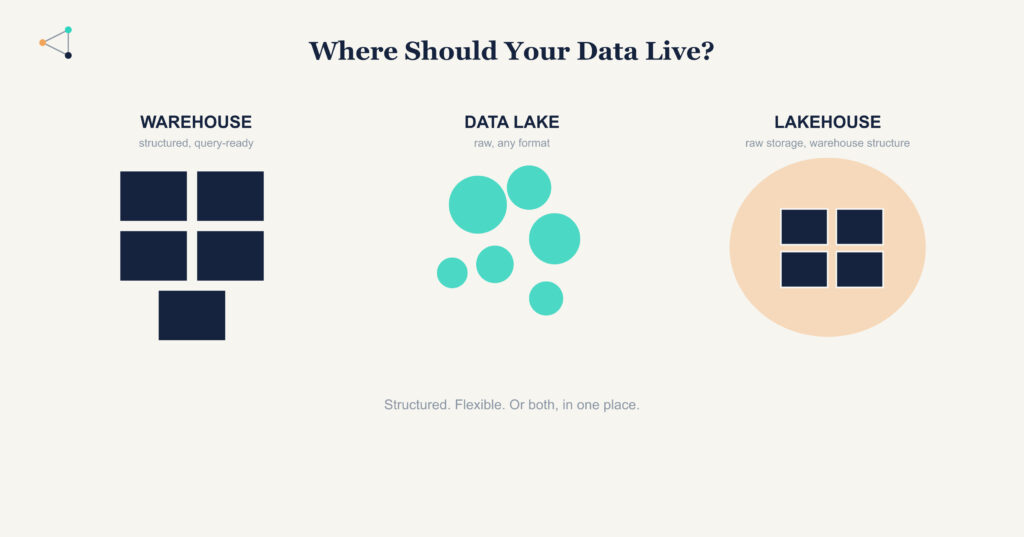
A data warehouse is a centralized repository designed to store structured, processed data — typically data that has already been cleaned and organized for business reporting and analysis. Examples include Amazon Redshift, Google BigQuery, and Snowflake.
Key characteristics:
- Data is structured and organized into tables, following a predefined schema (schema-on-write — meaning the structure is defined before data is loaded)
- Optimized for fast, complex queries used in business intelligence and reporting
- Typically holds data that has already gone through an ETL (Extract, Transform, Load) process
- Well-suited for historical analysis, dashboards, and standard business reporting
Best for:
Organizations that need reliable, fast answers to well-defined business questions — like quarterly revenue reports, customer segmentation, or sales trend analysis.
Data Lakes: Raw and Flexible
A data lake is a centralized repository that stores raw data in its native format — structured, semi-structured, or unstructured — without requiring it to be organized upfront. Examples include Amazon S3, Azure Data Lake Storage, and Hadoop-based systems.
Key characteristics:
- Stores everything: text, images, video, log files, sensor data, structured tables, and more
- Uses a schema-on-read approach — meaning structure is applied only when the data is actually analyzed, not when it’s stored
- Much more flexible and scalable for massive volumes of diverse data
- Often serves as the foundation for machine learning and advanced analytics projects
Best for:
Organizations dealing with large volumes of varied data types, especially when the use cases for that data (like training a machine learning model) aren’t fully defined yet.
The Trade-Off
Data lakes offer flexibility, but that flexibility comes with risk. Without proper governance, a data lake can become what’s commonly called a “data swamp” — a disorganized mass of data that’s difficult to search, trust, or use effectively.
Data Lakehouses: The Best of Both Worlds
A data lakehouse is a newer architecture that attempts to combine the flexibility and scalability of a data lake with the structure, reliability, and performance of a data warehouse. Platforms like Databricks and Snowflake (with newer capabilities) have popularized this approach.
Key characteristics:
- Stores raw data like a lake, but adds a management layer that enables schema enforcement, ACID transactions, and fast querying like a warehouse
- Supports both business intelligence reporting and machine learning workloads on the same underlying data
- Reduces the need to maintain separate systems (and duplicate data) for different teams and use cases
- Often built on open storage formats like Delta Lake, Apache Iceberg, or Apache Hudi
Best for:
Organizations that want a single, unified platform supporting both traditional analytics and modern data science/AI use cases, without maintaining two separate systems and duplicating data between them.
Side-by-Side Comparison
| Feature | Data Warehouse | Data Lake | Data Lakehouse |
|---|---|---|---|
| Data type | Structured only | Structured, semi-structured, unstructured | All types |
| Schema | Schema-on-write | Schema-on-read | Flexible, with enforcement options |
| Primary users | Business analysts | Data scientists, engineers | Both |
| Cost | Higher for large-scale raw storage | Lower-cost storage at scale | Varies, often optimized |
| Query performance | Fast, optimized | Slower without added tooling | Fast, warehouse-like |
| Governance risk | Low | Higher (risk of “data swamp”) | Improved via structured layer |
Which One Should You Choose?
- Choose a data warehouse if your primary need is fast, reliable business reporting on structured data you already understand well.
- Choose a data lake if you’re collecting large volumes of diverse data and expect to use it for machine learning, experimentation, or use cases you haven’t fully defined yet.
- Choose a data lakehouse if you want to avoid maintaining two separate systems and need both strong analytics performance and flexibility for AI/ML workloads on the same data.
Many large organizations end up using a combination of these approaches, depending on the maturity of their data strategy and the specific needs of different teams.
Conclusion
There’s no single “correct” system among data lakes, warehouses, and lakehouses — each serves a different purpose depending on how structured your data is and what you plan to do with it. As data architectures continue to evolve, the trend is clearly moving toward more unified systems, like the lakehouse, that reduce complexity while supporting both traditional reporting and modern AI-driven analytics.