
One of the earliest and most consequential decisions in building any data-driven application is choosing a database. Should you go with a traditional SQL (relational) database, or a NoSQL (non-relational) one? The answer depends entirely on what your data looks like and how you plan to use it.
What Is SQL?
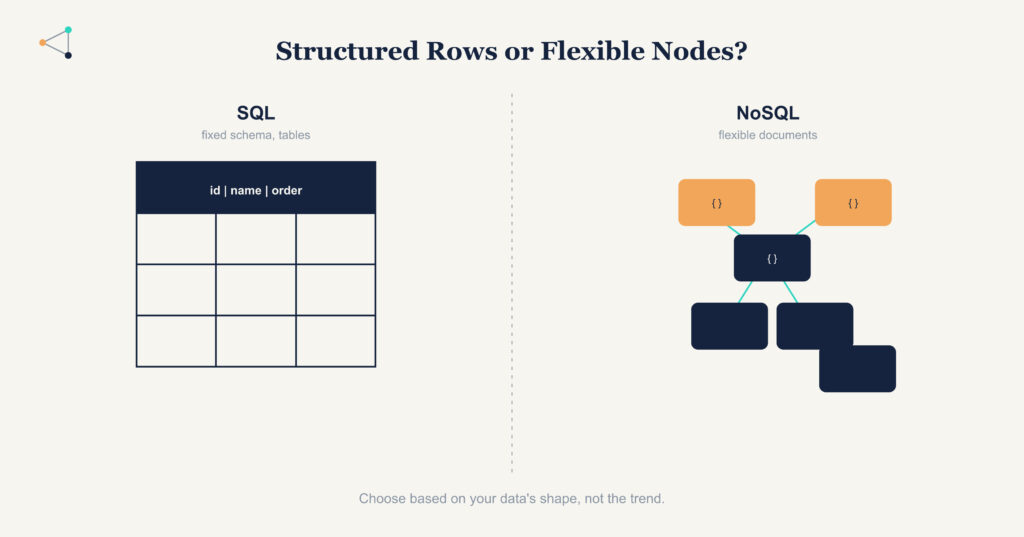
SQL (Structured Query Language) databases, also called relational databases, organize data into structured tables with predefined rows and columns — similar to a well-organized spreadsheet. Examples include:
- MySQL
- PostgreSQL
- Microsoft SQL Server
- Oracle Database
Each table has a fixed schema, meaning every entry must follow the same structure. Relationships between tables are established using keys (like a customer ID linking a “customers” table to an “orders” table).
Strengths of SQL
- Data integrity: Strong enforcement of relationships and constraints reduces the risk of inconsistent or duplicate data.
- ACID compliance: Transactions are Atomic, Consistent, Isolated, and Durable — critical for applications like banking, where accuracy is non-negotiable.
- Mature ecosystem: Decades of tooling, documentation, and community support.
- Complex queries: SQL excels at multi-table joins and complex relational queries.
Where SQL Struggles
- Rigid schema: Changing the structure of a large SQL database can be slow and disruptive.
- Vertical scaling: Traditional SQL databases typically scale by adding more power to a single server, which has physical and cost limits.
What Is NoSQL?
NoSQL (“Not Only SQL”) databases were built to handle data that doesn’t fit neatly into rows and columns, and to scale more flexibly across many servers. Common types include:
- Document databases (e.g., MongoDB) — store data as JSON-like documents
- Key-value stores (e.g., Redis) — simple pairs of keys and values, ideal for caching
- Column-family stores (e.g., Cassandra) — optimized for write-heavy workloads across distributed systems
- Graph databases (e.g., Neo4j) — designed for highly connected data, like social networks
Strengths of NoSQL
- Flexible schema: Fields can be added or changed without restructuring the entire database.
- Horizontal scaling: Designed to scale out across many servers, which suits large, distributed applications.
- Speed at scale: Well-suited for high-velocity data like real-time analytics, IoT sensor streams, or social media feeds.
- Handles unstructured data: Great for content like text, images, and nested/varying data structures.
Where NoSQL Struggles
- Weaker consistency guarantees: Many NoSQL systems favor availability and speed over strict consistency (though this varies by system).
- Less mature tooling for complex queries: Multi-entity relationships that SQL handles natively can require more manual work in NoSQL.
- Less standardization: Unlike SQL, there’s no single query language shared across all NoSQL systems.
Head-to-Head Comparison
| Factor | SQL | NoSQL |
|---|---|---|
| Data structure | Structured, tabular | Flexible: documents, key-value, graph, wide-column |
| Schema | Fixed, defined upfront | Dynamic, schema-less or flexible |
| Scaling | Primarily vertical | Primarily horizontal |
| Consistency | Strong (ACID) | Often eventual consistency (varies by system) |
| Best for | Transactional systems, structured relationships | Big data, real-time apps, rapidly evolving data |
| Query language | Standardized SQL | Varies by database |
How to Choose
Ask yourself these questions:
1. Is your data structured and relational? If your data naturally fits into tables with clear relationships (customers, orders, products), SQL is likely the better fit.
2. Do you need strict consistency and transactional accuracy? Financial systems, healthcare records, and inventory management typically benefit from SQL’s ACID guarantees.
3. Will your data structure change frequently? If your application is evolving rapidly and you’re not sure what fields you’ll need next month, NoSQL’s flexible schema can save significant rework.
4. Do you need to scale massively and quickly? If you’re building something like a social media platform or an IoT system generating millions of events per second, NoSQL’s horizontal scaling is often a better match.
5. What does your team already know? Practical reality matters. A team fluent in SQL may build a better product faster with a relational database, even if NoSQL seems theoretically superior for the use case.
A Hybrid Approach Is Common
Many modern applications don’t choose one over the other — they use both. For example, an e-commerce platform might use:
- A SQL database for orders, payments, and inventory (where consistency is critical)
- A NoSQL database for product catalogs, user sessions, or activity logs (where flexibility and scale matter more)
This is often called polyglot persistence — using the right database for each specific job rather than forcing everything into a single system.
Conclusion
There’s no universal “better” choice between SQL and NoSQL — only a better fit for your specific data, scale, and consistency needs. Start by understanding your data’s shape and your application’s requirements, and let those needs guide the decision rather than choosing based on trends alone.
Related articles
- Types of Databases Explained for Beginners: relational, document, key-value and more.
- MySQL vs PostgreSQL: Which Should You Use?: choosing between two popular SQL databases.
- How to Choose the Right Database Server: a practical checklist.
- Data Lakes vs. Data Warehouses vs. Data Lakehouses: where large amounts of data are stored.