
If you’ve spent any time in the tech world, you’ve likely heard the terms “big data,” “data science,” and “data analytics” used interchangeably. They’re related, but they are not the same thing. Understanding the distinction matters — whether you’re choosing a career path, building a team, or just trying to make sense of job postings that seem to blur all three together.
Big Data: The Raw Material
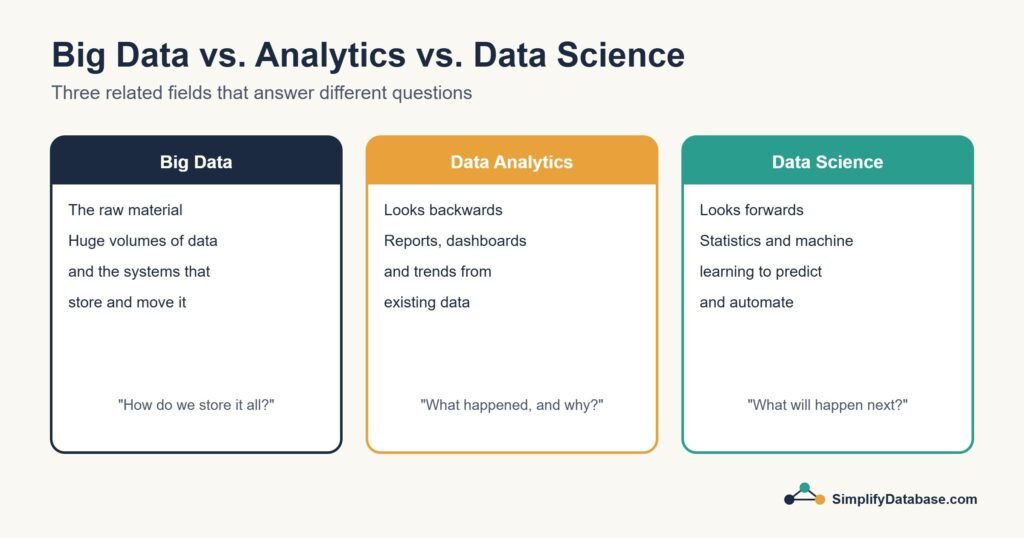
Big data refers to the massive, complex datasets that are too large or fast-moving for traditional tools to handle. Think of it as the raw material — the oil before it’s refined.
Big data is typically defined by characteristics like:
- Volume — enormous amounts of data (terabytes to petabytes)
- Velocity — data generated and processed at high speed
- Variety — data in many forms: text, images, video, sensor readings
- Veracity — the reliability and accuracy of that data
Big data on its own is just… data. It doesn’t tell you anything until someone works with it. Think of a warehouse full of unsorted inventory — valuable, but useless until organized and put to work.
Data Science: The Discipline That Extracts Meaning
Data science is the broader field that combines statistics, computer science, and domain expertise to extract knowledge and insights from data — including big data.
Data scientists:
- Build predictive models using machine learning
- Design algorithms to detect patterns
- Write code (often in Python or R) to process and model data
- Ask exploratory questions like “What will happen next?” or “What’s hidden in this data that we can’t see with the naked eye?”
Data science is less about looking backward and more about looking forward. A data scientist might build a model that predicts customer churn six months before it happens, or one that recommends products based on browsing behavior.
Data Analytics: The Discipline That Explains What Happened
Data analytics is a subset of the broader data science process, focused on examining datasets to draw conclusions about past or current performance. Analysts typically answer questions like:
- “What happened last quarter?”
- “Which marketing channel drove the most conversions?”
- “Why did sales dip in March?”
Data analytics often relies on tools like SQL, Excel, Tableau, or Power BI, and leans heavily on descriptive and diagnostic techniques rather than predictive modeling.
Side-by-Side Comparison
| Aspect | Big Data | Data Science | Data Analytics |
|---|---|---|---|
| What it is | The raw datasets themselves | The field that extracts insight from data | The practice of analyzing data for conclusions |
| Primary question | “How do we store and process this?” | “What can we predict or discover?” | “What happened, and why?” |
| Common tools | Hadoop, Spark, NoSQL databases | Python, R, TensorFlow, Jupyter | SQL, Excel, Tableau, Power BI |
| Time orientation | N/A (it’s the input) | Forward-looking (predictive) | Backward-looking (descriptive) |
| Typical output | Stored, processed datasets | Models, algorithms, predictions | Reports, dashboards, insights |
How They Work Together
In practice, these three areas overlap constantly. A retail company might collect big data from millions of customer transactions. A data analyst examines that data to report on last quarter’s top-selling products. Meanwhile, a data scientist builds a machine learning model using that same data to predict which products customers are likely to buy next.
None of these functions exist in a vacuum — big data provides the fuel, data science provides the engine, and data analytics provides the dashboard telling you how fast you’re going.
Which One Should You Learn?
If you’re deciding where to focus your career or your team’s hiring:
- Choose big data engineering if you enjoy building infrastructure, working with distributed systems, and solving storage/processing challenges.
- Choose data science if you’re drawn to statistics, machine learning, and building predictive systems.
- Choose data analytics if you enjoy storytelling with data, working with stakeholders, and answering business questions directly.
Conclusion
Big data, data science, and data analytics are three distinct but deeply interconnected pieces of the modern data ecosystem. Big data is the fuel, data science is the engine that turns it into predictions and models, and data analytics is the dashboard that helps people understand what’s already happened. Knowing the difference isn’t just semantics — it’s the first step toward building or joining the right kind of data team.
Related articles
- What is Big Data? Explained Simply for Beginners: the basics, with real examples.
- A Beginner’s Guide to the Data Science Lifecycle: from the business question to a deployed model.
- The Five Vs of Big Data Explained with Real Examples: volume, velocity, variety, veracity and value.
- SQL GROUP BY & Aggregate Functions Explained Simply: the SQL behind most analytics reports.
- OLTP vs OLAP Explained Simply: why analysts usually work on a separate copy of the data.
- Star Schema vs Snowflake Schema: the table design behind most reports and dashboards.