
Most people who try to learn SQL don’t fail because SQL is hard. They fail because they jump around: a video on joins, then a post about indexes, then a stored procedure tutorial, with nothing connecting them. After a few weeks they know many words but can’t write a real query on their own.
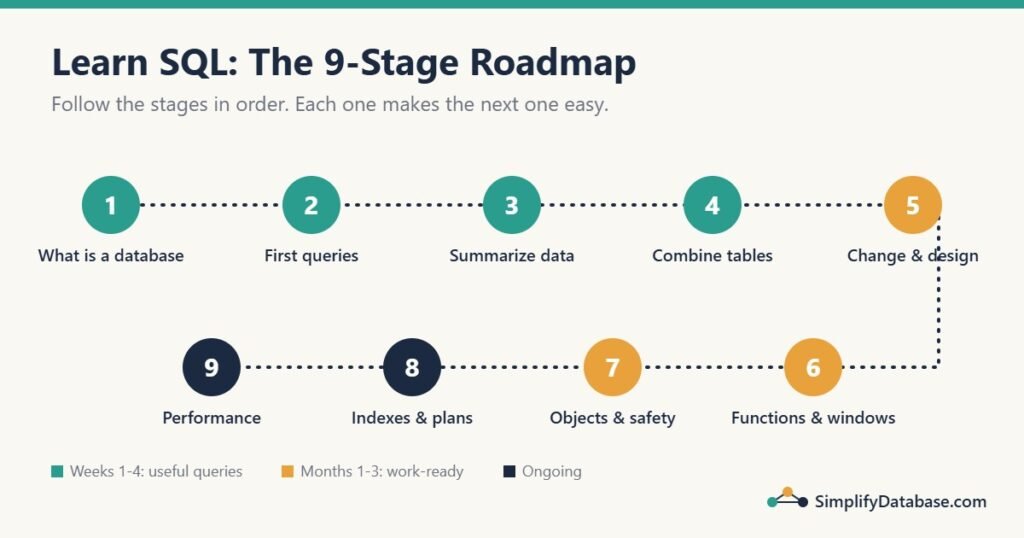
This roadmap fixes that. It splits SQL into 9 stages, in the order that makes each one easy. Every stage lists what to learn, a free tutorial on this site for each topic, and a simple test to check you’re ready to move on.
Before you start: three quick answers
How long does it take to learn SQL? With 30 to 60 minutes a day, most beginners can write useful queries (stages 1 to 4) in 2 to 4 weeks. Getting comfortable with the full roadmap takes about 2 to 3 months. Performance tuning (stage 9) is something you keep improving for years.
Which database should I learn? It matters less than you think: about 90% of SQL is the same everywhere. Pick one and stick with it:
| If you want to… | Start with |
|---|---|
| Work in a company that uses Microsoft tools, or with Delphi/.NET apps | SQL Server |
| Build websites (WordPress, PHP, Laravel) | MySQL |
| Do data analysis or use modern open-source tools | PostgreSQL |
Still unsure? Read MySQL vs PostgreSQL: Which Should You Use? and just pick one. You can switch later in a weekend.
Do I need to be good at maths or programming? No. If you can use a spreadsheet filter, you can learn SQL. SQL describes what you want, not how to get it.
Stage 1: Understand what a database is (1 to 2 days)
Don’t skip this. Five minutes of understanding here saves hours of confusion later.
- What Is a Database?: tables, rows and columns in plain English.
- Types of Databases Explained for Beginners: relational vs the rest.
- What Is a Database Server?: where the data actually lives.
- SQL vs Excel: if you come from spreadsheets, start here.
You’re ready when you can explain the difference between a table, a row and a column to a friend.
Stage 2: Write your first queries (3 to 5 days)
This is where you start typing SQL. Install your database (or use a free online playground) and type every example yourself. Copy-pasting teaches you nothing.
- SQL for Complete Beginners: Your First Queries:
SELECTandFROM. - SQL WHERE, ORDER BY and LIMIT Explained Simply: filter and sort rows.
- SQL LIKE, IN and BETWEEN Explained Simply: search text, match lists and ranges.
- NULL in SQL Explained Simply: the “missing value” that surprises everyone.
You’re ready when you can answer: “Show the 10 most expensive products in the ‘Laptops’ category whose name starts with ‘Dell’.”
Stage 3: Summarize data (3 to 5 days)
Most business questions are summaries: totals, counts, averages per customer or per month.
- SQL GROUP BY and Aggregate Functions Explained Simply:
COUNT,SUM,AVGper group. - HAVING vs WHERE in SQL: filter groups, not rows.
- The SQL CASE Expression Explained Simply: if/else inside a query.
You’re ready when you can answer: “Total sales per customer this year, only for customers who spent more than 1,000.”
Stage 4: Combine tables (1 to 2 weeks)
This is the stage that turns you from “knows some SQL” into “can actually use SQL at work”. Take your time here.
- Primary Keys vs Foreign Keys Explained for Beginners: how tables point to each other.
- SQL JOINs Explained Simply:
INNER,LEFT,RIGHTandFULLjoins. - UNION vs UNION ALL in SQL: stack results on top of each other.
- SQL Subqueries vs CTEs Explained Simply: queries inside queries.
You’re ready when you can list every customer with their number of orders, including customers with zero orders. (Hint: that needs a LEFT JOIN.)
Stage 5: Change data and design tables (1 to 2 weeks)
Until now you only read data. Now you create tables and change what’s in them.
- SQL INSERT, UPDATE and DELETE Explained Simply: always test with a
SELECTfirst. - SQL Data Types Explained Simply: choose the right type for each column.
- SQL Constraints Explained Simply: let the database reject bad data.
- Database Normalization Explained Simply: 1NF, 2NF and 3NF: split data into the right tables.
- SQL Transactions and ACID Explained Simply: all or nothing.
You’re ready when you can design 3 tables for a small library (books, members, loans) with keys and constraints, and fill them with data.
Stage 6: Functions and window functions (1 to 2 weeks)
Real data is messy. Functions clean and reshape it, and window functions answer questions that are painful with GROUP BY alone.
- SQL String Functions Explained Simply: trim, split and join text.
- SQL Date Functions Explained Simply: this month, last 30 days, age in years.
- SQL Window Functions Explained Simply:
ROW_NUMBER,RANK,LAG. - Running Totals in SQL Server: a cumulative sum and a running balance per account.
You’re ready when you can show each customer’s latest order, and a running total of sales by day.
Stage 7: Database objects and safety (1 week)
These are the tools you’ll meet in almost every company database.
- SQL Views Explained Simply: save a query as a virtual table.
- SQL Stored Procedures Explained Simply: reusable, parameterised SQL.
- SQL Triggers Explained Simply: code that runs automatically (use carefully).
- SQL Injection Explained Simply: the security mistake every developer must avoid.
- Database Backup and Restore Explained Simply: because one day you will need it.
You’re ready when you can explain why a parameterised query is safe and string-building is not.
Stage 8: Indexes and execution plans (1 to 2 weeks)
Your queries work. Now make them fast. This is where SQL developers start to stand out.
- SQL Indexes Explained Simply: the book index idea, clustered vs nonclustered.
- How to Read a SQL Server Execution Plan: see what the database actually does.
- Index Seek vs Index Scan: why SQL Server sometimes ignores your index.
- Missing Indexes in SQL Server: when to add an index, and when not to.
You’re ready when you can look at a slow query’s plan and point to the most expensive step.
Stage 9: Performance troubleshooting (ongoing)
This stage never really ends. Start with the step-by-step guide, then go deeper on each problem as you meet it in real life.
- SQL Server Performance Troubleshooting: A Practical Step-by-Step Guide: the full checklist from symptom to fix.
- SQL Server Parameter Sniffing: why a query is fast in SSMS but slow in the app.
- Eager Index Spool in SQL Server: a real slow-query case, step by step.
- How to Fix Query Timeout Issues in Delphi Applications: the application side of the same problem.
A simple weekly study plan
| Day | What to do | Time |
|---|---|---|
| Monday to Thursday | Read one tutorial and type every example yourself | 30 to 45 min |
| Friday | Write 5 queries on your own, without looking at the tutorial | 30 min |
| Saturday | Build something small: a table for your expenses, books or gym log | 1 hour |
| Sunday | Rest, or review the free SQL cheat sheet | 15 min |
Five mistakes that slow beginners down
- Watching instead of typing. You learn SQL with your fingers. Type every query, even the ones that look obvious.
- Skipping joins. Joins feel hard for a week, then suddenly click. Don’t move to stage 5 until they do.
- Learning three databases at once. Pick SQL Server, MySQL or PostgreSQL and stay with it until stage 6.
- Never using real data. Make a table of something you care about: your expenses, your football team’s results, your book list. Questions about your own data are more fun to answer.
- Memorising syntax. Nobody remembers every function. Learn the ideas, and keep a cheat sheet open for the syntax.
Want a book to go with the roadmap?
A good book gives you the same path in one place, with exercises. My picks are in 5 Best SQL Books for Absolute Beginners.
Conclusion
You don’t need a course, a bootcamp or a computer science degree to learn SQL. You need a clear order and a little practice every day. Start with stage 1 today, spend 30 minutes, and follow the stages in order. In a month you’ll be writing queries that answer real questions, and in three months you’ll understand more about databases than many people who’ve used them for years.
If you’re not sure where to begin on this site, the Start Here page has a quick tour.
Related articles
- SQL for Complete Beginners: Your First Queries: the very first step of stage 2.
- SQL JOINs Explained Simply: the most important topic in the whole roadmap.
- The 10 Best SQL and Database Books: books for every stage, beginner to advanced.