
So you’ve decided to learn SQL. Good choice. It’s one of the most useful skills you can pick up, whether you want to work with data, build apps or just stop being scared of the database at work.
The problem is choosing a book. Many SQL books assume you already know what a table is, or they bury the useful parts under hundreds of pages of theory. This list is different. Every book here was picked because it works for someone who has never written a query before.
Disclosure: some links on this page are affiliate links. If you buy through them, SimplifyDatabase may earn a small commission at no extra cost to you. It helps keep the site free.
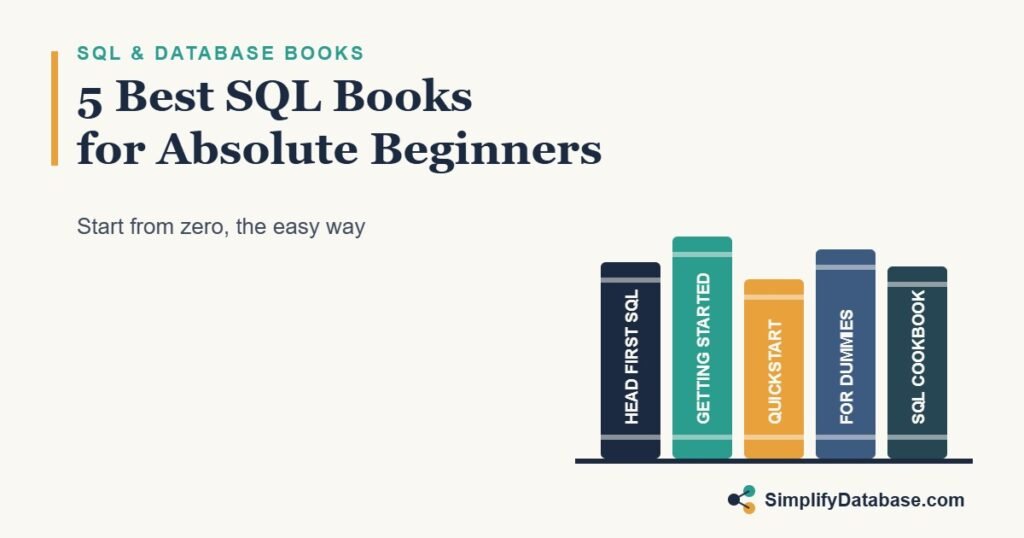
Quick Comparison
| Book | Style | Best for |
|---|---|---|
| Head First SQL | Visual, playful | People who get bored by textbooks |
| Getting Started with SQL | Short and hands-on | Learning the core in a weekend |
| SQL QuickStart Guide | Step by step, business focused | Office workers and analysts |
| SQL For Dummies | Broad, plain English | A friendly reference to keep on the desk |
| SQL Cookbook | Problem and solution recipes | Your second book, once the basics click |
1. Head First SQL
Author: Lynn Beighley (O’Reilly)
Head First books look nothing like normal textbooks. Pages are full of pictures, puzzles, conversations and jokes. That sounds gimmicky, but it works: the book is designed around how people actually remember things, and it keeps you active instead of just reading.
It walks you through creating tables, SELECT, WHERE, JOINs, subqueries and basic database design, using MySQL for the examples.
Why I recommend it: If you’ve opened a SQL book before and fallen asleep by page 20, this is the cure.
Keep in mind: it’s an older book, so some MySQL details are dated. The core SQL hasn’t changed, which is what matters at this stage.
2. Getting Started with SQL: A Hands-On Approach for Beginners
Author: Thomas Nield (O’Reilly)
This is a small book, under 150 pages, and that’s its biggest strength. Nield uses SQLite, a free database that runs as a single file, so you can start practising in minutes without installing a server.
It covers SELECT, filtering, aggregating with GROUP BY, CASE, joins, and even creating your own tables. Nothing more, nothing less.
Why I recommend it: You can finish it in a weekend and come out knowing the 20% of SQL you’ll use 80% of the time.
Keep in mind: it stops at the basics. You’ll want a second book afterwards.
3. SQL QuickStart Guide
Author: Walter Shields (ClydeBank Media)
Written with business users in mind, this book explains SQL through practical tasks like pulling sales figures or finding customers. It uses a sample database and the free SQLite tool DB Browser, so you can follow along on any computer.
Why I recommend it: If you work in an office and want to pull your own reports instead of waiting for IT, this book speaks your language.
Keep in mind: developers may find it too slow. It’s aimed at analysts and non-programmers.
4. SQL For Dummies
Author: Allen G. Taylor (Wiley)
The “For Dummies” name puts some people off, but this is a solid, wide-ranging introduction now in its 9th edition. It goes beyond queries into database design, data types, security and how SQL fits with other programming languages.
Why I recommend it: It’s a good desk reference. When you meet a new term at work, there’s a decent chance it’s explained here in plain English.
Keep in mind: it’s broad rather than deep, and it has fewer hands-on exercises than the books above.
5. SQL Cookbook (2nd Edition)
Authors: Anthony Molinaro and Robert de Graaf (O’Reilly)
This one is your next book, not your first. Each chapter is a set of recipes: a problem (“find the top three salaries in each department”), the SQL that solves it, and an explanation. Solutions are shown for SQL Server, MySQL, PostgreSQL, Oracle and DB2.
Why I recommend it: Once you know the basics, the hardest part is turning a real question into a query. This book trains exactly that skill.
Keep in mind: it assumes you already know SELECT, joins and GROUP BY. Read one of the books above first.
Which One Should You Pick?
- You learn best with pictures and humour: Head First SQL.
- You want results fast: Getting Started with SQL.
- You need SQL for reports at work: SQL QuickStart Guide.
- You want one book that covers a bit of everything: SQL For Dummies.
- You know the basics and want to solve real problems: SQL Cookbook.
Whichever you choose, type every example yourself. Reading SQL is easy; writing it is where the learning happens.
More Book Recommendations
Looking for something else? See our full list of the 10 best SQL and database books, or browse books by topic from the SQL Books menu: SQL Server, database design, performance tuning and big data. For a deep dive into one title at a time, check our book reviews.
Practise for Free While You Read
Pair your book with our free beginner guides: SQL for Complete Beginners, WHERE, ORDER BY and LIMIT and SQL JOINs. Reading a chapter, then practising the same idea here, is one of the fastest ways to make it stick.