
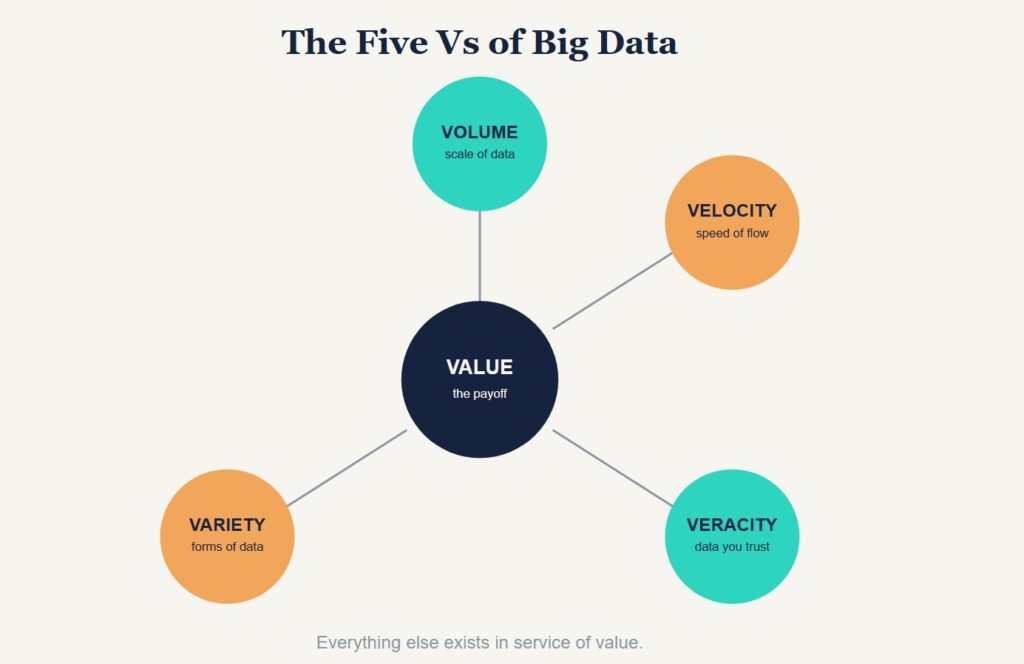
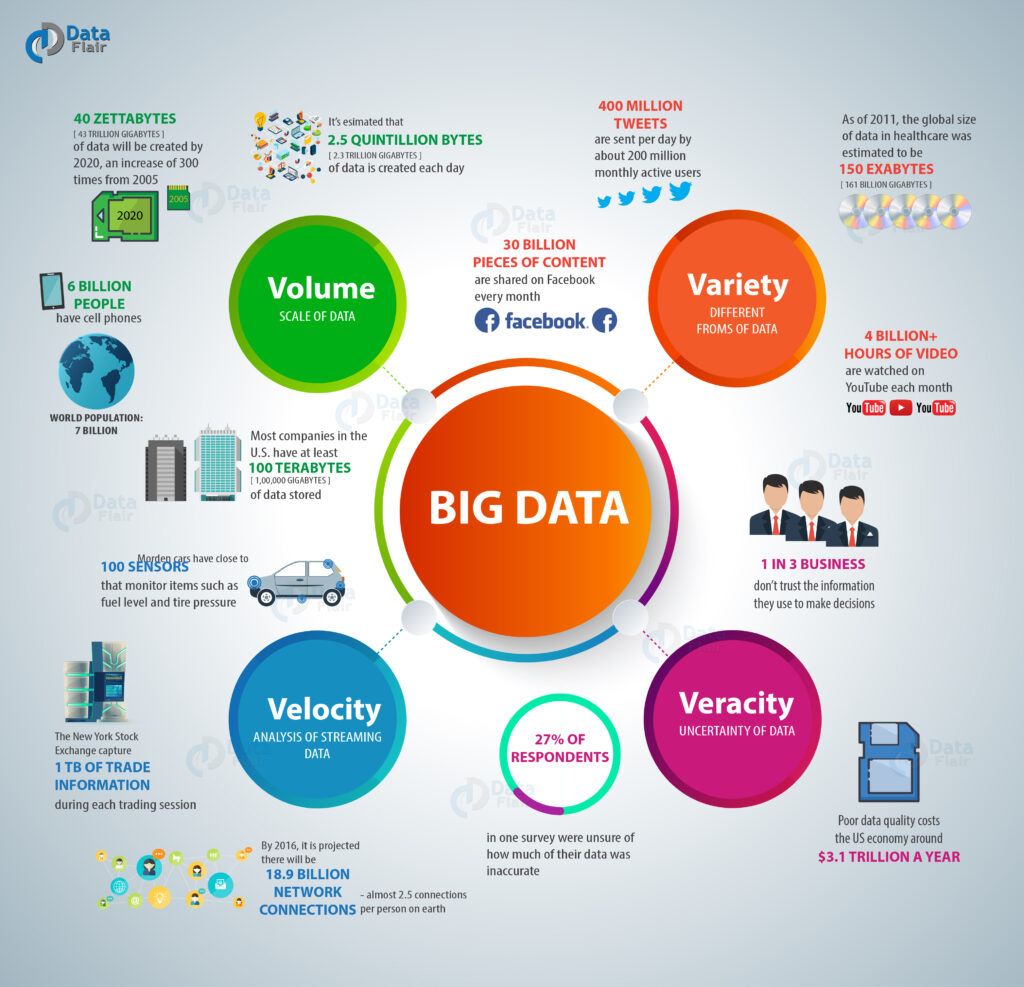
When people talk about “big data,” they often mean more than just “a lot of data.” What actually makes data “big” comes down to five defining characteristics, commonly known as the Five Vs: Volume, Velocity, Variety, Veracity, and Value. Understanding each one — with real-world context — makes the concept far more concrete.
1. Volume
Volume refers to the sheer scale of data being generated and stored. This is the most intuitive of the five Vs — it’s simply about size, often measured in terabytes, petabytes, or even exabytes.
Real example: Social media platforms process enormous volumes of data daily — billions of posts, likes, comments, and shares generated by users across the globe every single day. Storing and processing that volume requires distributed storage systems like Hadoop or cloud-based data lakes, since no single server could handle it.
2. Velocity
Velocity refers to the speed at which data is generated, collected, and needs to be processed. Some data can be analyzed later in batches, but a lot of modern data demands real-time or near-real-time processing.
Real example: Ride-sharing apps like Uber process location data from millions of drivers and riders continuously, updating estimated arrival times, pricing, and driver matching in real time. A delay of even a few seconds could mean an inaccurate fare or a mismatched ride. Technologies like Apache Kafka and Apache Spark Streaming were built specifically to handle this kind of high-velocity data.
3. Variety
Variety refers to the different forms data can take. Big data isn’t just spreadsheets and databases — it includes text, images, audio, video, sensor readings, and more, often gathered from many different sources at once.
Real example: A hospital system might combine structured data (patient records, lab results in a database), unstructured data (doctors’ handwritten or dictated notes), images (X-rays, MRIs), and sensor data (heart rate monitors) — all of which need to be processed together to get a full picture of a patient’s health. Handling this variety requires flexible storage systems, like data lakes, that don’t force everything into rigid tables.
4. Veracity
Veracity refers to the accuracy, trustworthiness, and quality of the data. Not all data is reliable — it can be incomplete, inconsistent, outdated, or simply wrong. Big data systems need mechanisms to assess and improve data quality before drawing conclusions from it.
Real example: During the analysis of social media sentiment about a product launch, a company might find fake reviews, bot-generated comments, or sarcastic posts that a simple sentiment analysis tool could misread as genuine praise or criticism. Without accounting for veracity, a company might make a costly business decision based on flawed conclusions.
5. Value
Value refers to the actual usefulness of the insights extracted from the data. Collecting massive amounts of high-velocity, varied, and accurate data means nothing if it doesn’t lead to meaningful outcomes — better decisions, new revenue, improved efficiency, or other measurable benefits.
Real example: A retail chain might collect years of point-of-sale transaction data, but the value only emerges when that data is used to identify which product bundles increase average order size, allowing the company to redesign store layouts or promotional offers accordingly. The data itself isn’t the win — the actionable insight is.
Why All Five Matter Together
These five characteristics don’t operate in isolation — they interact with and often complicate one another:
- High volume and velocity make it harder to ensure veracity, since there’s less time to verify each individual data point.
- High variety makes it harder to extract clear value, since combining structured and unstructured data requires more sophisticated processing.
- Ultimately, all four other Vs exist in service of the fifth: if data doesn’t lead to value, the effort of managing volume, velocity, variety, and veracity isn’t worth it.
Some experts have proposed additional Vs beyond the original five, including Variability (inconsistency in data flow over time) and Visualization (the ability to present data understandably) — a reminder that the concept of big data continues to evolve as technology and use cases grow more sophisticated.
Conclusion
The Five Vs provide a practical framework for understanding what actually makes data “big” — and more importantly, what makes it useful. Volume and velocity describe the scale and speed of data, variety captures its diverse forms, veracity addresses its reliability, and value ties it all back to the real-world outcomes that make the whole effort worthwhile. Any organization working with big data should keep all five in mind, not just the ones that are easiest to measure.