
What Is Big Data?
Every time you scroll through social media, make an online purchase, use a fitness tracker, or search for directions, you generate data. Multiply that by billions of people and devices acting every second, and you get an ocean of information so vast and fast-moving that traditional tools can’t handle it. This is what’s known as big data.
Big data is typically defined by what experts call the “Five Vs”:
- Volume — the sheer amount of data generated, often measured in terabytes, petabytes, or beyond.
- Velocity — the speed at which data is created and needs to be processed, sometimes in real time.
- Variety — the different forms data takes, including structured (spreadsheets, databases), unstructured (videos, images, social posts), and semi-structured data.
- Veracity — the trustworthiness and accuracy of the data.
- Value — the actual insight or business benefit that can be extracted from it.
Unlike traditional datasets that fit neatly into rows and columns, big data often comes from diverse and messy sources: sensors, mobile apps, customer transactions, machine logs, and more.
Why Big Data Matters
1. Better Decision-Making
Organizations no longer have to rely on gut instinct or small sample sizes. With big data, companies can analyze real patterns across millions of interactions to make evidence-based decisions — whether that’s choosing which product to launch, where to open a new store, or how to price a service.
2. Understanding Customers on a Deeper Level
Big data allows businesses to build detailed pictures of customer behavior: what they buy, when they buy it, and why they might stop. This enables highly personalized marketing, product recommendations, and customer service, turning generic interactions into tailored experiences.
3. Improving Efficiency and Reducing Costs
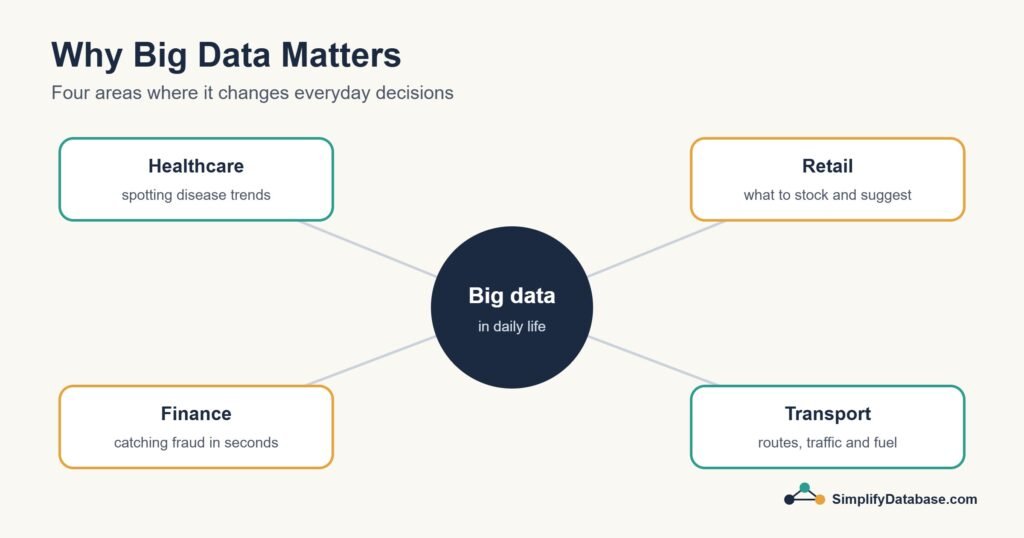
By analyzing operational data, companies can spot inefficiencies invisible to the naked eye. Manufacturing plants use sensor data to predict equipment failures before they happen (predictive maintenance), reducing downtime and repair costs. Logistics companies optimize delivery routes in real time to save fuel and time.
4. Powering Innovation
Big data is the fuel behind many of today’s most transformative technologies. Machine learning and artificial intelligence models require massive datasets to learn patterns and make predictions. Without big data, innovations like voice assistants, recommendation engines, fraud detection systems, and self-driving cars wouldn’t be possible.
5. Advancing Healthcare
In medicine, big data enables researchers to identify disease patterns across huge populations, accelerate drug discovery, and personalize treatment plans based on a patient’s genetic makeup and history. During public health crises, aggregated data helps track outbreaks and allocate resources effectively.
6. Strengthening Security
Big data analytics help detect fraud and cybersecurity threats by identifying unusual patterns in transactions or network traffic almost instantly — something that would be impossible to catch manually.
7. Supporting Smarter Cities and Governance
Governments use big data to manage traffic flow, optimize energy grids, and improve public services. Smart city initiatives rely on data from sensors, cameras, and citizen feedback to make urban life more efficient and sustainable.
Challenges to Consider
Big data isn’t without its difficulties. Organizations must navigate:
- Privacy concerns — balancing data collection with individuals’ right to privacy.
- Data quality — ensuring the information collected is accurate and relevant.
- Storage and infrastructure costs — managing the technical demands of storing and processing massive datasets.
- Skilled talent shortage — the need for data scientists and engineers who can extract meaningful insights.
Regulations like GDPR and various national data protection laws have emerged specifically to address these concerns, requiring organizations to be more transparent and responsible with the data they collect.
Conclusion
Big data has moved from being a buzzword to becoming a foundational part of how modern organizations operate. It shapes everything from the ads you see online to the medical treatments available to you, from how cities manage traffic to how businesses stay one step ahead of the competition. As data continues to grow in volume and complexity, the organizations — and societies — that learn to harness it responsibly will be the ones best positioned to thrive in the years ahead.