
A badly designed database causes problems for years: duplicate data, reports that never quite add up, and queries that get slower and more complicated every month. A well-designed one makes everything built on top of it easier.
Good design isn’t something you pick up by accident. These five books teach you how to model data, normalise tables and choose keys properly, from a complete beginner’s introduction to the theory behind it all.
Disclosure: some links on this page are affiliate links. If you buy through them, SimplifyDatabase may earn a small commission at no extra cost to you. It helps keep the site free.
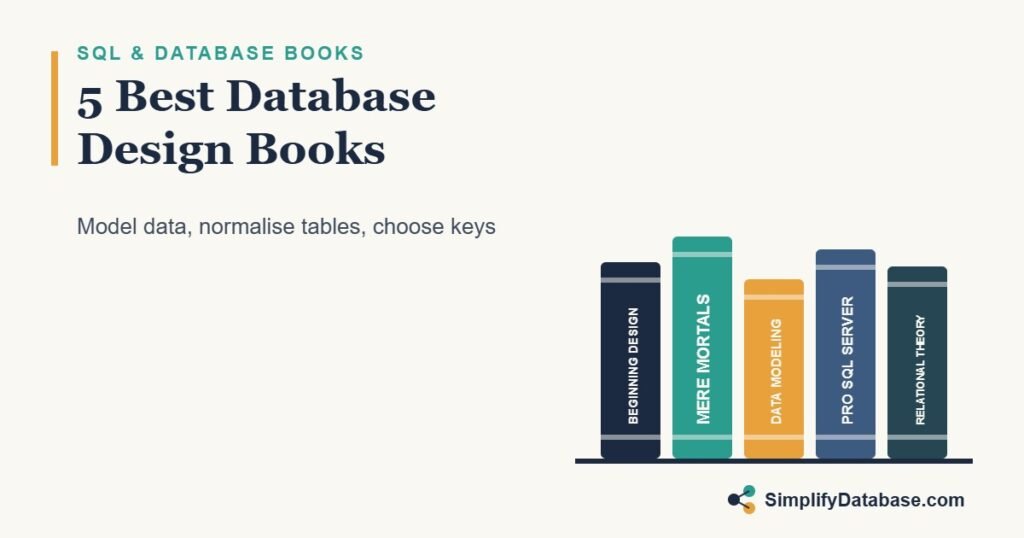
Quick Comparison
| Book | Level | Best for |
|---|---|---|
| Beginning Database Design | Beginner | Your very first data model |
| Database Design for Mere Mortals | Beginner to intermediate | A complete, step-by-step design process |
| Data Modeling Made Simple | Beginner to intermediate | Analysts and business-facing modelling |
| Pro SQL Server Relational Database Design and Implementation | Intermediate to advanced | Designing and building in SQL Server |
| Database Design and Relational Theory | Advanced | The theory behind normalization |
1. Beginning Database Design
Author: Clare Churcher (Apress)
Churcher starts with real problems, like a small business tracking customers and orders, and shows how to turn them into tables. She explains entities, relationships, keys and normalization through simple examples, and she’s honest about the mistakes beginners make (and why).
Why I recommend it: It’s the gentlest introduction to design we know, and it focuses on thinking, not on any particular database product.
Keep in mind: the 2nd edition is from 2012. Database design principles haven’t changed, so this matters less than you’d think.
2. Database Design for Mere Mortals
Author: Michael J. Hernandez (Addison-Wesley)
A classic that has helped people design databases for over 25 years. Hernandez lays out a complete design process: interviewing users, defining the mission of the database, identifying tables and fields, choosing keys, setting up relationships and defining business rules. It avoids heavy theory and uses plain language throughout.
Why I recommend it: It gives you a process you can actually follow on a real project, from the first meeting to the finished design.
Keep in mind: it’s long, and the interview-heavy process can feel slow if you just want to design a few tables.
3. Data Modeling Made Simple
Author: Steve Hoberman (Technics Publications)
Hoberman is one of the best-known names in data modelling. This book explains conceptual, logical and physical data models and how to read and draw them, with lots of exercises. It’s especially good for business analysts and anyone who needs to discuss data models with non-technical people.
Why I recommend it: It teaches data modelling as a communication tool, which is how it’s used in most companies.
Keep in mind: it’s lighter on SQL itself. You’ll design the model here and implement it elsewhere.
4. Pro SQL Server Relational Database Design and Implementation
Author: Louis Davidson (Apress)
This is where design meets a real database product. Davidson covers requirements, conceptual modelling and normalization, then moves into implementation in SQL Server: data types, constraints, keys, concurrency, security, indexing basics and common design patterns. The current 6th edition covers SQL Server 2019 and Azure SQL.
Why I recommend it: If you build databases on SQL Server, it bridges the gap between theory and the CREATE TABLE script.
Keep in mind: it’s big and assumes some T-SQL experience.
5. Database Design and Relational Theory
Author: C. J. Date (Apress)
C. J. Date worked with Ted Codd, the inventor of the relational model, and has written about it for decades. This book explains normalization properly: functional dependencies, the normal forms up to fifth normal form, and why they matter. The 2nd edition was published in 2019.
Why I recommend it: If you want to really understand why normalization works, not just follow rules, this is the source.
Keep in mind: it’s rigorous and academic. Read one of the books above first.
Which One Is Right for You?
- First time designing a database: Beginning Database Design.
- Need a process for a real project: Database Design for Mere Mortals.
- You work between business and IT: Data Modeling Made Simple.
- You design on SQL Server: Pro SQL Server Relational Database Design.
- You love the “why”: Database Design and Relational Theory.
Learn the Basics Here First
Our free guides cover the core ideas these books build on: what is a database, primary keys vs foreign keys, database normalization: 1NF, 2NF and 3NF, SQL constraints and SQL data types.
Want more recommendations? See the best SQL books for beginners, the best SQL Server books, or browse our book reviews from the SQL Books menu.