
If you can write a JOIN, a GROUP BY and a window function, you already have the most important skill in data engineering. Data engineers spend much of their day writing SQL: moving data, cleaning it, reshaping it and making it fast to query. What they add on top is knowing how to build pipelines that do this reliably, on a schedule, at scale.
This roadmap is for people who know SQL (developers, analysts, report writers, DBAs) and want to move into data engineering. It lists what to learn, in what order, and what to skip at first, with links to free guides on this site for each step.
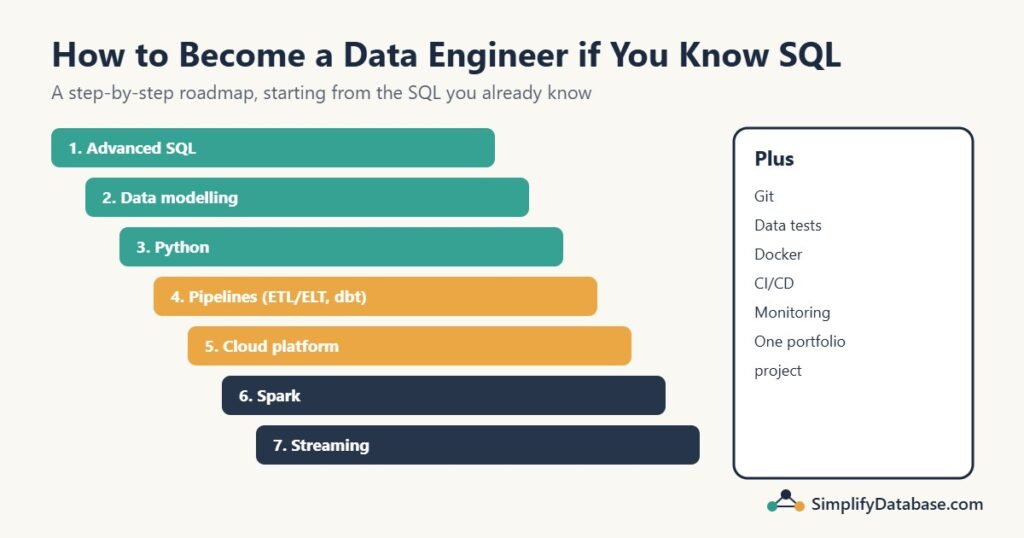
Table of Contents
What a data engineer actually does
A data engineer builds and runs the systems that get data from where it’s created to where it’s used:
- Extract data from sources: application databases (SQL Server, MySQL), files, APIs, event streams.
- Transform it: clean it, join it, remove duplicates, calculate totals, apply business rules.
- Load it into a data warehouse or data lake where analysts, dashboards and data scientists use it.
- Keep it running: schedule jobs, monitor them, fix failures, make them faster and cheaper.
Compared with neighbouring roles:
| Role | Main question | Main tools |
|---|---|---|
| Data analyst | What does the data tell us? | SQL, Excel, Power BI / Tableau |
| Data engineer | How do we get trustworthy data to everyone, every day? | SQL, Python, pipelines, warehouses, Spark |
| Data scientist | What will happen, and why? | Python, statistics, machine learning |
| DBA | Is the database healthy, fast and safe? | SQL Server / MySQL internals, backups, tuning |
If you’ve ever written a nightly job that copies data into a reporting database, you’ve already done a small version of data engineering.
Stage 1: Go deeper with SQL (you’re probably halfway there)
Data engineering SQL is more than SELECT. Make sure you’re comfortable with:
- Joins of every kind, and spotting duplicate rows they create.
GROUP BY,HAVING, and window functions:ROW_NUMBER,LAG, running totals.- CTEs and breaking a big transformation into steps (Subqueries vs CTEs).
- Removing duplicates and cleaning messy data.
- Loading changes: MERGE and upsert, incremental loads.
- Date logic: calendar tables, month-over-month comparisons.
- Reading execution plans and knowing why a query is slow.
You’re ready when you can take a messy table of raw orders, remove duplicates, fix types and produce a clean daily summary in one well-structured SQL script.
If you need to start from the basics, follow How to Learn SQL: A Step-by-Step Roadmap first.
Stage 2: Learn how analytical data is modelled
Application databases are designed for fast inserts and updates. Analytical databases are designed for fast reading of large amounts of history. Learn the difference and the standard patterns:
- OLTP vs OLAP: why you don’t run heavy reports on the live database.
- Star schema vs snowflake schema: fact and dimension tables.
- Database normalization, so you know what you’re denormalizing and why.
- Slowly changing dimensions: how to keep history when a customer moves city.
- Data lakes vs data warehouses vs lakehouses.
You’re ready when you can design a small star schema for a sales business (a fact table and four dimensions) and explain the grain of the fact table in one sentence.
Stage 3: Learn enough Python
SQL does the transformations; Python does almost everything around them: calling APIs, reading files, orchestrating steps, testing, automating. You don’t need to become a software engineer. Focus on:
- The basics: variables, lists, dictionaries, loops, functions, error handling.
- Reading and writing files (CSV, JSON) and calling REST APIs with
requests. - Connecting to databases and running SQL from Python.
- pandas for small and medium data: see SQL vs Python (pandas) for Data Analysis, which maps pandas to the SQL you know.
- Writing a script that runs from the command line and logs what it does.
You’re ready when you can write a script that downloads a CSV from a URL, loads it into a database table, and runs a SQL transformation afterwards.
Stage 4: Build pipelines (ETL, ELT and orchestration)
This is the heart of the job. Learn the concepts first, then one tool for each:
- ETL vs ELT: transform before loading, or load first and transform in the warehouse.
- Full vs incremental loads: reloading everything vs loading only new and changed rows with a “last loaded” watermark.
- Idempotency: a job you can safely run twice without doubling the data. (Upserts and “delete then insert for this date” are the usual techniques.)
- Orchestration: running steps in order, on a schedule, with retries and alerts. Apache Airflow is the best-known tool; Microsoft shops often use Azure Data Factory or SSIS.
- dbt: writes transformations as SQL
SELECTstatements, with dependencies, tests and documentation. It’s very popular and a natural next step for SQL developers. - Data quality: tests for nulls, duplicates, valid values and row counts after each load.
You’re ready when you can build a pipeline that loads a source table incrementally every hour, transforms it into a fact table, runs data tests, and can be re-run for any past day without creating duplicates.
Stage 5: Learn one cloud data platform
Most data engineering jobs today involve a cloud warehouse or lakehouse. Pick one and learn it well; the ideas transfer:
- Microsoft: Azure Synapse / Microsoft Fabric, Azure Data Factory. A natural choice if you come from SQL Server.
- Snowflake: a popular cloud data warehouse, very SQL-friendly.
- Google BigQuery: serverless warehouse, pay per query.
- Amazon Redshift, with AWS Glue for pipelines.
- Databricks: a lakehouse platform built on Apache Spark.
Learn how storage and compute are billed, how to load data, how to control cost (partitioning, clustering, not scanning whole tables), and basic security (roles, access to tables). Free tiers and trial accounts are enough to learn.
Stage 6: Big data with Spark (when the data outgrows one machine)
When data is too big for one database server, processing moves to a cluster. Apache Spark is the standard engine, and you can use it with plain SQL:
- What Is Apache Spark? A Simple Guide for SQL Users.
- File formats: Parquet (columnar), and table formats like Delta Lake and Iceberg that add updates and transactions on top of files.
- Partitioning data on disk instead of relying on indexes.
You’re ready when you can read a folder of Parquet files with Spark, transform them with Spark SQL and write the result back partitioned by date.
Stage 7: Streaming (only after the basics)
Some data needs to be processed within seconds: fraud checks, live dashboards, alerts. Learn the concepts before the tools:
- Batch vs stream processing: event time, windows, late data.
- Apache Kafka as the event log in the middle.
- Change data capture (CDC): turning database changes into events.
Many data engineering roles involve little or no streaming. Don’t start here.
Stage 8: The engineering habits
What separates a data engineer from someone who writes good queries is how the work is built and maintained:
- Git for every SQL file and script, with pull requests and code review.
- Testing: data tests in dbt or your pipeline, plus a few checks you run after every load.
- Docker basics, so a pipeline runs the same on your laptop and on the server.
- CI/CD: changes deployed automatically after tests pass.
- Monitoring and documentation: knowing a job failed before the business notices, and leaving notes the next person can follow.
- Performance and cost: indexes and plans in databases, partitioning and file sizes in lakes. The SQL Server performance troubleshooting guide is good practice for this mindset.
A realistic six-month plan
Studying around 8-10 hours a week alongside a job:
| Month | Focus | Output |
|---|---|---|
| 1 | Advanced SQL (Stage 1) | A set of solved exercises: duplicates, window functions, upserts |
| 2 | Data modelling (Stage 2) | A star schema design for a sample business |
| 3 | Python basics (Stage 3) | A script that loads a CSV or API into a database |
| 4 | Pipelines with dbt and Airflow (Stage 4) | An incremental pipeline with tests |
| 5 | One cloud platform (Stage 5) | The same pipeline running in the cloud |
| 6 | Spark basics + portfolio polish (Stage 6) | A finished portfolio project on GitHub |
Streaming, Docker and CI/CD can come after your first data engineering role. Nobody knows everything on day one.
A portfolio project that shows the whole job
Employers want to see that you can build an end-to-end pipeline, not just write queries. A good project:
- Source: a public dataset or API that updates regularly (exchange rates, weather, public transport, open government data).
- Ingest: a Python script that pulls new data every day into a raw table or folder.
- Transform: SQL (ideally dbt) that cleans it into a star schema: one fact table, a few dimensions, a calendar dimension.
- Test: checks for duplicates, nulls and expected row counts.
- Orchestrate: a daily schedule (Airflow, or even a simple scheduler to start).
- Serve: a small dashboard or a few analytical queries answering real questions.
- Document: a README with a diagram, how to run it, and what you’d improve.
Put it on GitHub. In interviews, be ready to explain your choices: why incremental, how you handle late data, what happens if the job runs twice.
Coming from a developer or DBA background
If you already work with SQL Server, MySQL, Laravel or Delphi applications, you have advantages: you understand transactions, indexes, the cost of a bad query, and what application data looks like at the source. Lean on that:
- Build a reporting copy or small warehouse from one of your own systems’ databases (with permission).
- Move a nightly report from “query on the live database” to “pipeline into a reporting table”. That’s a data engineering project on your CV.
- Learn CDC, because you already know where the changes happen.
Interview preparation
Expect three kinds of questions:
- SQL: joins, window functions, duplicates, top N per group, gaps and islands. Practise with 25 SQL Interview Questions for Beginners, then harder ones.
- Design: “Design a pipeline that loads orders every hour into a warehouse.” Talk about sources, incremental loads, idempotency, the data model, tests and monitoring.
- Concepts: OLTP vs OLAP, ETL vs ELT, star schema, batch vs streaming, partitioning, and the trade-offs between them.
Common mistakes when switching
- Starting with tools instead of concepts. Airflow, Kafka and Spark are easier once you understand pipelines, models and incremental loads.
- Collecting certificates without building anything. One complete project beats five course certificates.
- Neglecting SQL because it feels basic. It’s the skill you’ll use every single day.
- Learning three clouds at once. Learn one well.
- Jumping into streaming and “big data” before solving ordinary batch problems cleanly.
Summary
- Data engineering is building reliable pipelines that turn raw data into trustworthy tables, and SQL is its core skill.
- Learn in this order: advanced SQL → data modelling → Python → pipelines (ETL/ELT, dbt, orchestration) → one cloud platform → Spark → streaming, with engineering habits throughout.
- Build one end-to-end portfolio project and be ready to explain every decision in it.
- If you already work with databases, you’re closer than you think: start by building a proper pipeline for data you already know.
Related articles
- How to Learn SQL: A Step-by-Step Roadmap: the SQL foundation this roadmap builds on.
- SQL for Data Analysis: A Step-by-Step Roadmap: the analyst path, if that suits you better.
- ETL vs ELT Explained Simply: the pipelines at the centre of the job.
- 5 Best Big Data and Data Engineering Books for SQL Users: including Fundamentals of Data Engineering.